
Geomancy (ʿIlm al-Raml · Sand Divination)
Pure digital algorithmic forecasting: medieval Arabic scholars engineered a complete boolean algebra system 700 years before George Boole formalised mathematical logic.
Core Symbolic & State Mechanism
A practitioner pokes 16 rows of rapid, uncounted dots into soft desert sand or parchment. Dots in each row are counted modulo 2 (odd = single point, even = double point), generating 4 four-line binary figures called the 'Four Mothers'. Through mathematical addition modulo 2 (XOR logic), these generate 12 subsequent figures in a 16-house Shield Chart.
Stochastic Randomization Algorithm
Modulo-2 binary addition: four 4-bit nibbles ($2^4 = 16$ possible figures) recursively combined via bitwise XOR operations to determine Daughters, Nieces, Witnesses, and the Judge.
Key Historical Treatises & Artifacts
- British Museum Islamic Geomantic Brass Instrument by Muhammad ibn Khutlukh (1241 CE)
- Treatise of Abu 'Abdallah al-Zanati (c. 1200 CE)
- De Geomantia by Cornelius Agrippa (1531 CE)
Primary Archaeological Artifacts & Facsimiles
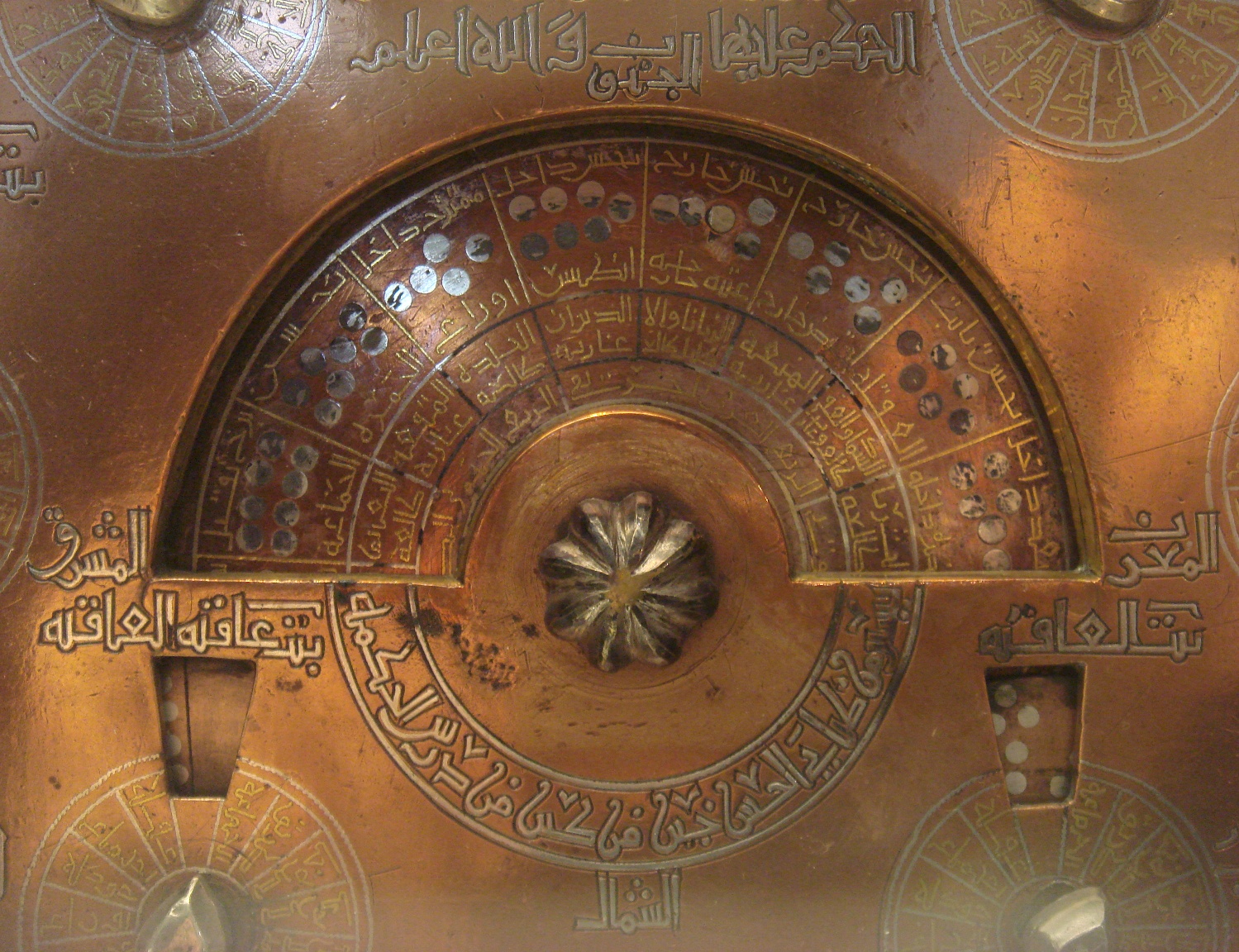
Islamic Brass Geomantic Calculating Instrument
Mechanical 16-Figure Mantic State Engine by Muhammad ibn Khutlukh
Mechanical computing device featuring 16 rotating dials, sliding registers, and inlaid silver astrological correspondences designed to automate the generation and generation of the 16 geomantic figures (*‘Ilm al-Raml*).
Demonstrates that medieval Islamic geomancy was conceptualized as a precise, formal mathematical binary computing system with mechanical computation pre-dating Babbage and modern digital logic.
Generates the 16-point shield chart from 4 primordial Mother figures using mod-2 binary synthesis.
Celestial Ephemeris & Astronomical Timing: Medieval Arabic sand-figures were calculated alongside the 28 Arabic Lunar Mansions (Manazil al-Qamar).