
Historical Lineages & Traditions
Follow the evolutionary arc of Tarot from Renaissance court triumphi to 17th-century woodblock prints, Enlightenment occult revivals, and 20th-century non-Euclidean quantum geometries.
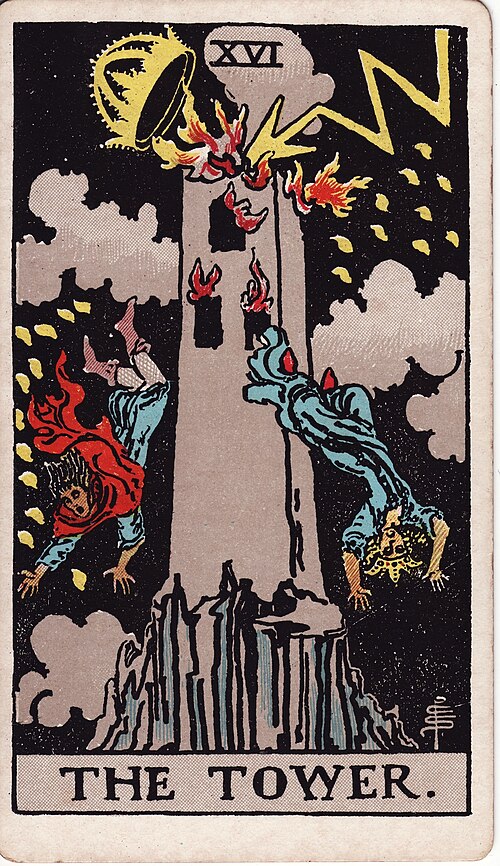
How The Tower Evolved Across Historical Decks
Rider-Waite-Smith (First Edition) (1909)
Origin: London, England · Medium: Pen and ink line with watercolor washes
Iconographical Shift & Hermeneutic Evolution
Radically codified: added the Golden Dawn Pe (Path 27) martial fire, 22 descending Hebrew Yods, and the golden crown knocked off by the lightning bolt of reality.
Visconti-Sforza Trionfi
Innovators: Bonifacio Bembo, Filippo Maria Visconti, Francesco Sforza
The oldest surviving luxury Tarot decks created for the Milanese ducal court as an allegorical triumph game (Tarocchi).
Visual Iconography & Craft Style
High Renaissance court miniatures with punchwork gold leaf and tempera on pressed cardboard.
Primary Systemic Innovations
- Introduction of the 22 allegorical Trionfi (Triumphs) alongside the four Latin court suits.
- Visual representations of Petrarchan allegories (Love, Chastity, Death, Fame, Time, Eternity).
- No titles or numbers printed on cards; identified by Renaissance court iconography.
Intellectual & Historical Milieu
Created as an aristocratic parlor game and humanist didactic device celebrating ducal alliances and virtue, long before esoteric or occult reinterpretation.